
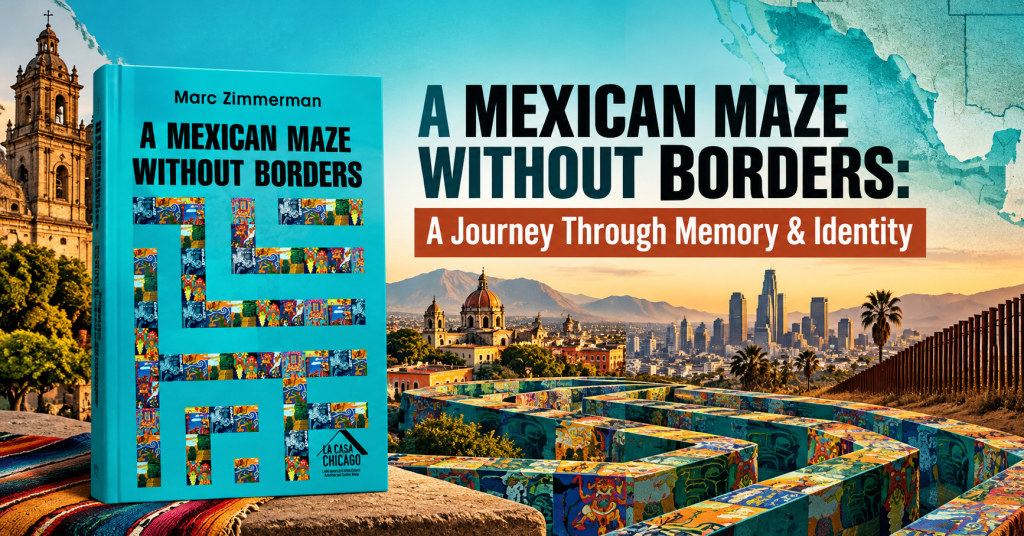

A Literary Journey Through Mexico, America, Memory, and Human Connection
Some journeys are measured in miles. Others are measured in the people we meet, the relationships we lose, the places that remain with us, and the memories that continue to change long after we leave them behind. Marc Zimmerman’s A Mexican Maze Without Borders belongs firmly to the second kind.
Part of Zimmerman’s Illusions of Memory autofiction series, the book moves across cities, countries, communities, relationships, and different stages of a life. At the centre is Mel, a vulnerable and often impulsive protagonist whose encounters with Mexican, Chicano, Latino, Jewish, LGBTQ, literary, and artistic communities gradually reshape the way he understands himself and the worlds around him. Rather than following a straight path, the narrative moves like the maze promised in its title, taking the reader from one memory, person, and place to another.
What begins as a story rooted in Mexican experience quickly becomes something broader. Mexico is not confined to a single geography in Zimmerman’s work. It appears in memory, literature, friendship, romance, identity, migration, grief, and cultural exchange. The book travels through the borderlands, Minneapolis, Mexico City, Chicago, Houston, Baja, Sinaloa, Chihuahua, Jalisco, Acapulco, Los Angeles, Michoacán, and other points north and south. These locations do more than provide scenery. Each one adds another passage to the maze through which Mel moves.
A Border That Exists, and a World That Refuses to Stay Behind It
Borders normally tell us where one place ends and another begins. They create categories: one country on this side, another country on that side. Yet human experience is rarely so orderly.
Throughout A Mexican Maze Without Borders, Mexican and American worlds repeatedly overlap. Chicano identity complicates simple national definitions. Relationships cross ethnic and cultural boundaries. Writers move between languages and literary traditions. Memories connect places that may be separated geographically but remain emotionally inseparable.
Zimmerman describes this world as a labyrinth “sin fronteras,” or without borders. That phrase captures much of the book’s central energy. The border remains present, but it cannot completely contain culture, memory, affection, language, or identity. Mel encounters writers, lovers, intellectuals, outsiders, migrants, artists, criminals, friends, and people whose lives resist easy classification. Through them, the reader encounters Mexico not as a distant or isolated subject, but as something woven into a much larger cultural and personal landscape.
This is what makes the title especially effective. The “maze” is geographical, but it is also psychological and emotional. Every new place introduces another relationship, memory, mistake, or discovery. Instead of leading toward one simple understanding of Mexico, the book continually opens new directions.
Mel: An Imperfect Traveller Through an Uncertain World
At the centre of the book is Mel, and one of the more compelling aspects of the character is that Zimmerman does not present him as a confident or flawless guide.
Mel can be reckless, insecure, curious, emotionally complicated, and uncertain. He makes mistakes, enters relationships that do not always end well, attracted to people and places he does not always fully understand. His experiences are shaped as much by confusion and regret as by insight.
That imperfection gives the autofiction its tension.
Rather than presenting a narrator who has mastered every culture or relationship he encounters, Zimmerman allows Mel to remain unfinished. He learns through attraction, loss, misunderstanding, desire, disappointment, and repeated attempts to make sense of unfamiliar worlds. His encounters include Mexican and Chicano writers, a Chicano convict with possible criminal connections, women in Minnesota, relationships across different cultural backgrounds, travels through various parts of Mexico, and romantic experiences affected by both personal insecurity and wider economic circumstances.
The result is a protagonist who often seems to be searching without fully knowing what he hopes to find. That search gives the book much of its emotional honesty. Mel’s journey is not one of simple enlightenment. It is a life assembled from pieces, and not all of those pieces fit comfortably together.
Love, Desire, Loss, and the People Who Complicate the Journey
Relationships form one of the strongest currents running through the book. They are rarely simple, and Zimmerman seems particularly interested in the way intimacy can expose cultural difference, personal insecurity, and emotional contradiction.
A Mexico City love affair is affected by both private uncertainty and economic collapse. Relationships in Chicago dissolve or disappear. A French-Mexican and Jewish mis-alliance introduces another layer of cultural complexity. Journeys through different regions of Mexico bring their own encounters, attractions, and consequences.
One of the more striking figures described in the book is a Mexican transgender woman whose life moves through sex work, drinking, drugs, and instability toward the possibility of committed love and marriage. Her presence fits the larger pattern of the book: people are allowed to remain complicated. They are not reduced to symbols of a particular identity or social category. They enter Mel’s life as human beings capable of changing, disturbing, attracting, confusing, or educating him.
Grief becomes another form of cultural crossing. One episode centres on an Ashkenazi mother from Los Angeles who is finally mourned by her estranged son during a Noche de Muertos in a Michoacán cemetery. Jewish memory and Mexican ritual come together in one emotional moment, demonstrating how cultures can intersect most powerfully through the experiences people use to understand love, death, family, and remembrance.
These moments show why the book cannot easily be reduced to a conventional travel narrative. Places matter, but the people encountered within them matter more.
When Writers Become Part of the Story
Literature itself occupies an important place in A Mexican Maze Without Borders. Carlos Fuentes, Octavio Paz, Carlos Monsiváis, Luis Alberto Urrea, Rolando Hinojosa, and other named and unnamed writers appear within the world Zimmerman creates.
Their presence gives the narrative another layer. Mexico is experienced not only through streets, journeys, romance, politics, and cultural encounters, but also through books and writers. Literature becomes part of lived experience.
For Zimmerman, whose work has long engaged with Central American, Mexican, Caribbean, and U.S. Latino themes, this makes sense. Writers are not distant figures encountered only on a bookshelf. They belong to conversations, intellectual networks, memories, friendships, and cultural debates.
The book therefore becomes partly about the ways literature shapes our understanding of a place. Mexico exists as geography, but it also exists through the stories told about it, the writers who interpret it, and the readers who carry those interpretations elsewhere.
Zimmerman’s work has received praise from writers and scholars including Luis Alberto Urrea, Roberto Márquez, John Beverley, Marta E. Sánchez, Carolina Rivera Escamilla, and Antonio Zavala. Their responses point toward the literary and cultural breadth of a body of work concerned with memory, ethnicity, migration, identity, and the unpredictable connections between people.
The Maze of Memory
The larger series title, Illusions of Memory, is important to understanding the book.
Memory is rarely an exact record of the past. We remember selectively. Certain moments become more vivid with time, while others disappear. People who once seemed peripheral may later become central to the way we understand an entire period of our lives. Places change in memory. Relationships acquire meanings they did not seem to possess while we were living through them.
Autofiction gives Zimmerman room to work inside that uncertainty.
Instead of promising a purely documentary reconstruction of life, the form allows memory and imagination to meet. Personal experience becomes literary material, and the act of remembering becomes part of the story itself.
Seen this way, the maze in A Mexican Maze Without Borders operates on several levels at once. There is the physical maze of cities, countries, highways, borderlands, and journeys. There is the cultural maze of Mexican, Chicano, Jewish, American, and other identities. There is the emotional maze of lovers, friendships, regrets, disappointments, and grief.
Then there is memory itself, perhaps the most difficult maze of all.
Mel keeps moving through each of them, revisiting people and experiences while trying to understand what they meant then and what they mean now.
Mexico Is More Than a Place on the Map
One of the most interesting ideas running beneath the book is that Mexico cannot be contained within a single definition.
Mexico appears through cities and villages, literature and relationships, travel and migration, celebration and mourning. Mexican cultural experience extends north through Chicano communities, families, friendships, writers, and traditions in the United States.
This raises questions that extend far beyond Mel’s individual story.
Where does one culture truly end and another begin? Can someone develop an emotional connection to a place without belonging to it geographically? How much of our understanding of another culture is shaped by the people we meet rather than by the country itself? What happens to identity when people live between languages, traditions, communities, or national boundaries?
Zimmerman does not reduce these questions to simple answers. Instead, the narrative allows them to emerge through lived experience.
That makes the book less concerned with defining Mexican identity than with showing how complicated any attempt at definition becomes once real people are involved.
Final words
Marc Zimmerman has written and edited more than forty books, with significant attention to Central American, Mexican, Caribbean, and U.S. Latino themes. Within the Illusions of Memory autofiction series, works such as The Border Trilogy, Black, Brown and White on the Border, and Sandino on the Border contribute to a continuing literary exploration of ethnicity, politics, migration, memory, intimacy, and cultural encounter.
Yet A Mexican Maze Without Borders feels particularly concerned with the unpredictability of human connection.
People enter Mel’s life and change its direction. Some remain only briefly. Some leave painful memories. Some become sources of affection, confusion, danger, disappointment, fascination, or grief. They do not necessarily provide answers. Instead, together they become the maze through which his understanding of Mexico, America, and himself develops.
That may be the most fitting meaning of “without borders.” Human experience rarely respects the boundaries we create for it. Love crosses borders. Grief crosses borders. Literature crosses borders. Memory crosses borders. Identity crosses borders.
And once those crossings begin, returning to a perfectly divided world may no longer be possible.
A Mexican Maze Without Borders follows those movements wherever they lead, creating a wide-ranging portrait of one man navigating Mexican and Mexican American worlds while revisiting the people, cultures, relationships, and memories that continue to shape his life. For readers drawn to autofiction, Mexican and Latino cultural experience, literary memory, complicated human relationships, and stories that resist neat categories, Zimmerman offers not a straight road but a labyrinth, one filled with unexpected entrances, difficult turns, and memories that refuse to remain on only one side of the border.