

Exploring Childhood, Culture, and the Early Forces That Shape Who We Become
Childhood rarely feels important while we are living it. A school day is simply a school day. A family argument passes. A summer afternoon disappears into another. A song catches our attention, a friendship begins, a belief is questioned, and life moves on. Only years later do we begin to understand that these seemingly ordinary moments may have been quietly shaping the person we would become.
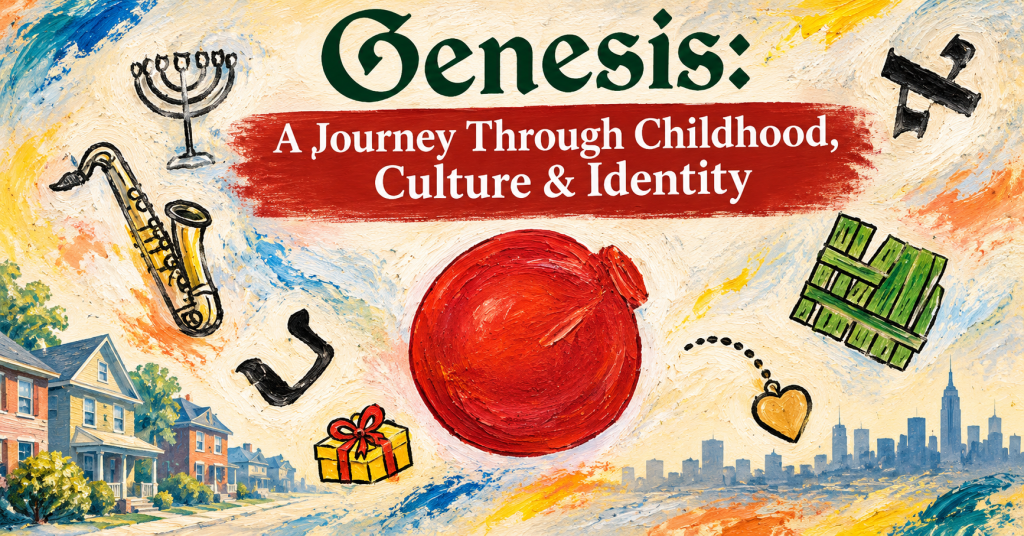
That idea sits at the heart of Marc Zimmerman’s Genesis: Seeds of Being in the Early Years of a New Jersey Jewish-American. Rather than treating childhood as a collection of sentimental memories, Zimmerman revisits his earliest years to explore how identity is formed through family, religion, history, place, culture, friendship, loss, and discovery. Set largely in the Newark and Elizabeth areas of New Jersey, within the cultural pull of nearby New York City, the book follows the young Mel as his world gradually expands beyond home, school, and community.
Genesis is deeply personal, but it is never isolated from the larger world. Mel’s memories unfold against some of the defining events and anxieties of post-war America, including the Holocaust’s continuing shadow, the Cold War, McCarthyism, the Rosenberg Case, and the establishment of Israel. Zimmerman brings these historical forces into the intimate territory of childhood, showing how events that may appear distant on a timeline can enter family conversations, religious identity, political awareness, and a young person’s developing understanding of belonging.
A Childhood Lived in the Shadow of a Changing America
Mel grows up as a middle-class Ashkenazi Jewish American at a time when both America and Jewish identity are undergoing profound change. The Second World War has ended, but the consequences of the Holocaust remain painfully present. Israel has been founded, creating new questions about Jewish history, homeland, identity, and responsibility. At the same time, American society is entering the Cold War period, when fear of communism, political suspicion, and ideological conformity become powerful forces in public life.
For a child beginning to interpret the world, these developments do not arrive as tidy historical lessons. They are absorbed through adults, neighbourhoods, newspapers, conversations, anxieties, and the atmosphere of the period. Zimmerman uses this environment to examine how historical events gradually become personal. The Rosenberg Case, McCarthyism, and questions surrounding Jewish identity are not simply events happening “out there.” They become part of the cultural landscape through which Mel begins to understand who he is and where he belongs.
This gives Genesis a scope much larger than a conventional childhood memoir. The book is interested in the way private lives are formed inside public history. Family traditions, political events, religious beliefs, neighbourhood identities, and national anxieties all exist at the same time, influencing one another whether the young Mel fully understands them or not.
When Inherited Beliefs Begin to Be Questioned
One of the most important developments in Mel’s early life is his changing relationship with faith and Jewish community. Childhood often begins with inherited structures. We accept the customs, beliefs, expectations, and identities that surround us because they are simply part of the world we know. Growing older, however, brings questions.
In Genesis, Mel’s eventual loss of God and growing distance from his religious community are presented as part of a broader intellectual and emotional awakening. His movement away from faith does not leave an empty space. Instead, it creates room for new sources of meaning. Music, writing, art, other cultures, and new relationships begin to occupy territory once defined primarily by inherited belief.
This transition gives the book much of its emotional complexity. Zimmerman is not merely describing a young person abandoning one identity and choosing another. He is examining how identity evolves through uncertainty. Mel carries aspects of his Jewish upbringing even as he questions its religious foundations. The past does not disappear simply because belief changes. It remains present in memory, family, cultural awareness, and the questions he continues to ask.
Jazz Opens a Different Door into America
Among the discoveries that begin reshaping Mel’s world, jazz becomes especially significant. Music introduces him to a form of expression that feels freer, more improvisational, and culturally expansive than many of the structures surrounding his early life.
Jazz is not presented simply as a musical preference. It becomes part of Mel’s growing awareness of an America larger and more complicated than the one he initially knows. Through it comes a deeper awareness of African American life and culture, along with questions about race, creativity, social difference, and artistic freedom. At the same time, Mel becomes increasingly conscious of Italian Americans and other communities around him, gradually recognising that American identity is not one story but many stories existing beside, within, and sometimes against one another.
Writing soon becomes another important form of discovery. Language offers Mel a way to examine the contradictions he encounters. It allows him to process desire, alienation, cultural difference, family experience, belief, and memory. The would-be artist begins to emerge not through one dramatic revelation, but through a series of encounters that slowly change the way he sees the world.
In this sense, Genesis is also a portrait of a writer before he fully becomes a writer. The reader sees the earliest conditions from which a literary consciousness develops.
When Memory Becomes Something More Than Recollection
Zimmerman’s approach to the past is central to what makes Genesis distinctive. He describes his broader work in terms of “memoir fiction,” narratives in which memories become the foundations for fictional constructions. The distinction matters because the book is not presented as a simple chronological record of exactly what happened.
Memory is unstable. Some childhood moments remain astonishingly clear decades later, while others fade almost entirely. We remember feelings without conversations, places without dates, faces without names. We also reinterpret the past each time we revisit it, because the person remembering is no longer the person who originally lived through the event.
Zimmerman makes that uncertainty part of the literary method. In Genesis, memory is not treated as a flawless archive. It is material to be examined, questioned, reconstructed, and sometimes transformed through imagination. The book therefore asks something more interesting than whether every remembered detail happened precisely as described. It asks what those remembered moments have become over time and why they continued to matter.
That approach connects Genesis directly to the larger Illusions of Memory project. The “illusion” is not necessarily that memory is false, but that remembering can ever be completely neutral. Every act of remembrance contains perspective, distance, emotion, and interpretation.
Where the Personal and the Historical Refuse to Stay Separate
One of the most compelling qualities of Zimmerman’s project is the way he allows personal experience and historical reality to occupy the same page.
The Holocaust belongs to world history, but it also enters Jewish family memory. McCarthyism belongs to American political history, but its atmosphere affects ordinary people. The founding of Israel is an international event, but it carries deeply personal meanings for Jewish communities across the world. Jazz is an art form, but it is also inseparable from questions of race, culture, history, and American identity.
This blending of scales gives Genesis its particular texture. A private childhood is never entirely private because the world is always entering it. Political events alter conversations. Cultural movements change tastes. Historical trauma shapes identity even for those born after it. Music opens doors to communities that once seemed distant.
The young Mel may not yet possess the language to explain all these forces, but the older narrator can look backward and see how they were already shaping the trajectory of his life.
The First Chapter of a Much Larger Literary Journey
Genesis also holds an important place within Zimmerman’s broader body of work because it opens Cycle II of his autofiction series. The book is therefore not only about beginnings thematically; it is also a point of origin within a much larger literary journey.
Later works in Cycle II, including Two Ways West, No Light from Heaven, Black, Brown and White on the Border, and Managua mon amour, Nevermore, continue Zimmerman’s exploration of identity, politics, travel, relationships, culture, and memory. The childhood questions introduced in Genesis become foundations for the wider geographical and intellectual journeys that follow.
This is why the word “seeds” in the subtitle feels especially important. The book is concerned with experiences whose significance becomes visible only in retrospect. Early encounters with religion, race, music, family, history, and literature contain the beginnings of later interests that will carry Zimmerman across borders, cultures, political movements, and decades of writing.
Luis Alberto Urrea’s description of Zimmerman as “a wonderful writer” speaks to the literary quality of a project that has grown across numerous books and forms. John Beverley, meanwhile, has characterised the larger Illusions of Memory project as a sprawling mixture of memoir, diary, Bildungsroman, travelogue, and short-story collection. That mixture is already visible in Genesis, where autobiography becomes a starting point rather than a limitation.
The Seeds of a Life Are Often Invisible Until Years Later
Ultimately, Genesis: Seeds of Being in the Early Years of a New Jersey Jewish-American is about the mysterious process of becoming.
No single event creates a person. Identity accumulates. It grows from family and rebellion, faith and doubt, neighbourhood and nation, friendship and isolation, art and history. Sometimes a seemingly minor childhood experience becomes more influential than an event that once appeared enormous.
Zimmerman returns to these early years because the beginnings of later life are already present within them. The attraction to writing is beginning. The fascination with culture is beginning. The questions about Jewish identity are beginning. The awareness of other American communities is widening. The relationship between private memory and public history is taking shape.
That makes Genesis far more than a nostalgic portrait of growing up in New Jersey. It is an attempt to understand how the person looking backward was created by the child moving forward without yet knowing where the journey would lead.
For readers interested in Jewish-American experience, post-war America, literary memory, cultural identity, autofiction, and the development of a writer’s consciousness, Genesis offers an intimate beginning to a much larger story. It reminds us that the earliest chapters of our lives may never truly disappear. They remain beneath everything that follows, quietly shaping the stories we tell about ourselves.