
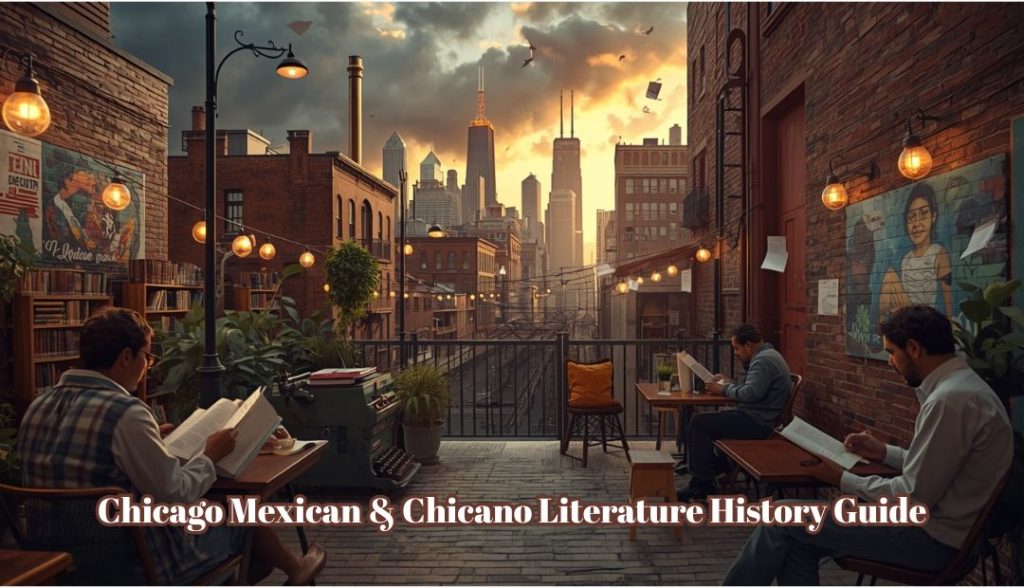

For much of American literary history, Chicago has been treated primarily as an industrial city rather than an imaginative one. Its skyline, railroads, stockyards, and steel mills have dominated the cultural picture, while its literary life, especially that produced by marginalized communities, has often been relegated to the margins. When Mexican and Chicano writing enters the national conversation, scholarly and popular attention has traditionally drifted southwest, toward Texas, California, and borderlands shaped by Spanish colonization, territorial conquest, and mythic geographies of Aztlán.
What the Rise of Mexican and Chicano Literature in Chicago does, quietly but decisively, is shift that map.
Rather than positioning Chicago as a secondary or derivative site, the book insists on the city as a generative literary force in its own right. It argues that Mexican and Chicano writing in Chicago emerged under conditions profoundly different from those of the Southwest, and that those differences matter. Chicago’s Mexican and Chicano literature did not grow out of inherited colonial memory or proximity to the border. It emerged from industrial labor, internal migration, racialized urban space, and the pressures of a modern capitalist city. In doing so, it produced forms of writing that broadened, complicated, and ultimately reshaped U.S. Chicano and Latino literary traditions.
Literature as Lived History, Not Academic Abstraction
One of the book’s defining strengths is its insistence that literature cannot be separated from history, or from the city that produces it. Rather than treating texts as isolated aesthetic objects, The Rise of Mexican and Chicano Literature in Chicago approaches them as historical documents embedded in lived experience. Migration, labor, schooling, neighborhood formation, political struggle, and cultural exchange are not background context here; they are constitutive forces shaping narrative voice, form, and urgency.
Chicago Mexican and Chicano writers did not inherit the same cultural frameworks as their Southwest counterparts. They arrived in a city without Spanish colonial roots and without a longstanding Chicano mythos tied to land reclamation or border memory. Instead, they entered a modern industrial metropolis that demanded adaptation, resistance, and reinvention. Many came directly from Mexico to work in steel mills, factories, and service industries. Others were born into neighborhoods structured by class, race, and labor discipline rather than agrarian or borderland traditions.
Their writing reflects this difference. It is unmistakably urban, plural, and shaped by proximity to other working-class and ethnic communities, Irish, Polish, Jewish, African American, Puerto Rican, and others. The result is a literature deeply aware of contradiction and negotiation. Identity is not asserted through inherited mythology alone, but through daily encounters with power, exploitation, solidarity, and displacement. Writing becomes a way of documenting how people lived, worked, loved, and resisted in a city that rarely made space for their stories.
Recovery of Voices and Cultural Presence
At its core, this work is an act of recovery. Many of the writers and texts examined in The Rise of Mexican and Chicano Literature in Chicago were never fully absorbed into national literary canons. Some were forgotten altogether. Others were overshadowed by Southwest-centred narratives that became dominant within Chicano literary studies. By reconstructing their contexts, neighborhoods, presses, collectives, classrooms, churches, and movements, the book restores not only texts, but cultural presence.
This recovery matters because these writers were not merely reflecting their environment; they were actively shaping identity and community in real time. Poetry, short stories, essays, and critical writing functioned as testimony, resistance, and self-definition. Literature became a way to insist on presence in a city that frequently rendered Mexican and Chicano communities invisible or interchangeable.
The book shows how writing emerged from concrete cultural spaces: Hull House workshops, barrio schools, student movements, small presses, activist networks, and informal literary circles. These were not elite or isolated spaces. They were grounded in neighborhoods and shaped by political urgency. Writing was forged in response to social pressure, economic exploitation, and cultural erasure.
What emerges is not a single unified tradition, but a layered literary ecosystem, one that evolves across generations and neighborhoods. Early Mexican writing rooted in working-class survival gives way to Chicano poetry shaped by activism, followed by feminist and experimental voices that challenge earlier forms. The book traces this evolution without flattening it, allowing contradiction, tension, and transformation to remain visible.
Chicago’s Distinct Contribution to Chicano and Latino Literature
Perhaps the book’s most important intervention is its argument that Chicago Mexican and Chicano literature is not a regional footnote. It is a distinct and consequential contribution to U.S. and Latino literary history. By tracing early settlement patterns, educational experiences, labor conditions, and cultural production, the book demonstrates how Chicago writers broadened the scope of what Chicano literature could be.
Chicago’s writers complicate dominant frameworks rooted in the Southwest. They challenge assumptions about space, identity, and tradition by showing how Chicano and Latino identities take shape in industrial, multicultural urban environments. Chicago emerges as a site of “de-homogenization,” where literary expression is shaped by proximity to multiple ethnic traditions, by factory labor rather than agricultural work, and by urban displacement rather than territorial loss alone.
This perspective also reframes familiar figures. Writers such as Ana Castillo and Sandra Cisneros are situated not only as national literary icons, but as products of specific Chicago geographies, Hull House, Taylor Street, Pilsen, Humboldt Park, each leaving a trace on their early work. Their writing cannot be fully understood without recognizing the Chicago contexts that shaped their voices.
In this way, the book does more than recover neglected writers. It challenges the field itself, calling for a broader understanding of Chicano and Latino literature that accounts for regional difference, urban modernity, and transethnic exchange.
Why This Book Matters Now
Today, readers are increasingly drawn to nonfiction that uncovers erased or overlooked histories, especially those that illuminate how present-day conversations about identity, migration, and cultural power were formed. The Rise of Mexican and Chicano Literature in Chicago offers exactly that lineage.
At a moment when questions of representation, belonging, and voice are central to public discourse, this book provides historical depth. It explains how literature functioned as cultural survival, how voices emerged under pressure, and how a city shaped a literary tradition that still resonates. Importantly, it does so without reducing writing to theory alone. Literature here is lived, contested, and deeply human.
For readers outside academic circles, the book offers something rare: an accessible yet rigorous account of how writing becomes a form of presence, how cities produce literature, and how stories resist disappearance. It invites readers to see Chicago not only as a site of industry, but as a crucible of cultural imagination.
Chicago has always been more than factories and railroads. The Rise of Mexican and Chicano Literature in Chicago reminds us that it has also been a city of words, and that those words, forged in struggle and creativity, deserve to be read.