
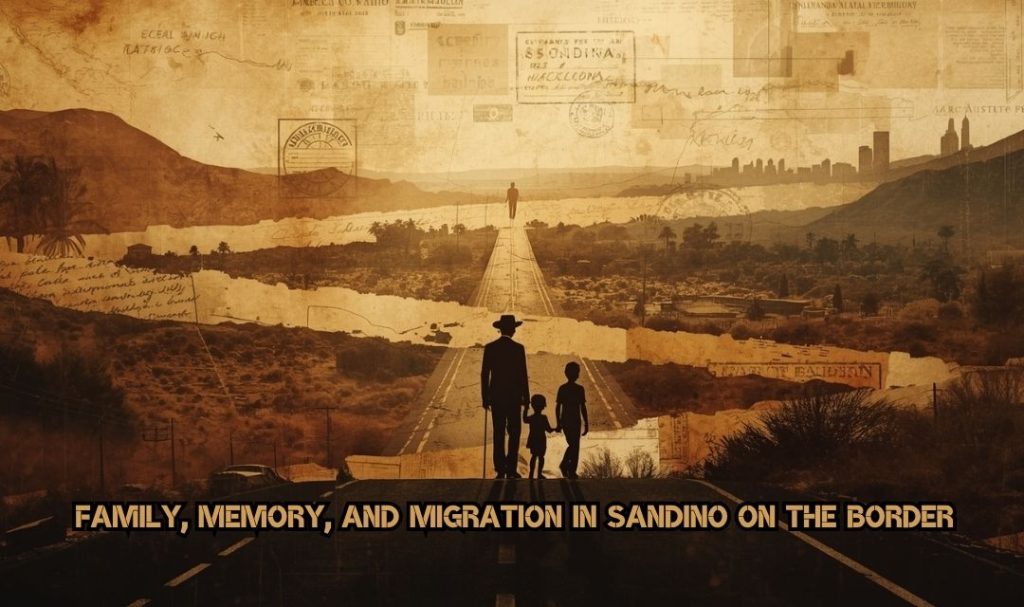

Marc Zimmerman’s Sandino on the Border is not just a novel. It is a sweeping, multi-layered exploration of identity, displacement, family, memory, and political history. Though published only a few years ago, the book continues to feel deeply relevant because the issues it explores—migration, borders, cultural identity, political struggle, and fractured families—remain central to today’s world.
As part of Zimmerman’s acclaimed Illusions of Memory series, the book has received praise from leading literary voices. Luis Alberto Urrea calls Zimmerman “a wonderful writer,” while Dick Goldberg describes the work as “an incredible opus.” Literary critic John Beverley notes that there is “nothing like this series in American fiction.” These endorsements reflect the novel’s depth, ambition, and lasting literary importance.
But what exactly makes Sandino on the Border so significant, and why does it continue to resonate with readers today?
A Story Rooted in Family, Fracture, and Borders
At the heart of the novel is a deeply human story: a Nicaraguan doctor takes his son across the border, leaving behind a fractured family struggling to survive in the aftermath. This single act sets into motion a narrative that spans countries, generations, and emotional landscapes.
Through Lena, her children, and Mel, a Jewish American who becomes closely involved in their struggle, the novel explores what it means to rebuild life after rupture. The emotional weight of separation, the resilience required to endure it, and the evolving meaning of family all form the emotional backbone of the story.
This is not only a story of loss. It is also a story of connection across difference. Cultural, geographical, and emotional boundaries blur as characters search for belonging, reminding readers that family is often something we create as much as something we inherit.
The Power of Political Context: The Sandinista Revolution
What elevates Sandino on the Border beyond personal drama is its grounding in real historical events, especially the Sandinista Revolution. Zimmerman does not treat history as background. Instead, political history actively shapes the lives, choices, and identities of his characters.
Through Lena’s extended family, the novel captures the lived experience of revolution, migration, and survival. An uncle involved in border crossings, a mother connected to smuggling, and relatives spread across different countries all reveal how political upheaval enters ordinary lives in intimate and lasting ways.
The presence of César Augusto Sandino, Nicaragua’s national hero, adds symbolic power to the narrative. Sandino’s legacy represents both resistance and the complexity of revolutionary ideals. His influence reminds readers that political struggles do not remain confined to the past. They echo through families, borders, and generations.
A Unique Literary Style That Mirrors Real Life
One of the most striking aspects of Sandino on the Border is its narrative structure. Zimmerman uses a multi-voiced storytelling approach that allows readers to experience events through different emotional, cultural, and political perspectives.
This fragmented structure is not just a stylistic choice. It reflects the reality of transnational life. Memory, identity, and belonging are rarely simple or linear, especially for people navigating multiple cultures and histories. The novel’s form mirrors this complexity, making the reading experience immersive and thought-provoking.
The epilogue further expands the book’s literary richness, drawing on echoes of John Keats, F. Scott Fitzgerald, and Ernest Hemingway. This blending of influences gives the narrative a timeless quality while still keeping its themes connected to the modern world.
Migration, Identity, and a World Shaped by Borders
One of the strongest reasons Sandino on the Border remains relevant today is its exploration of migration and identity. The novel’s characters move across Baja, Southern California, Minneapolis, Chicago, Mexico City, and Managua, reflecting the interconnected realities of modern life.
In today’s world, where migration continues to shape public debate and personal experience, the book’s themes feel especially current. Families separated by borders, individuals navigating multiple identities, and the emotional toll of displacement are not distant concerns. They are ongoing realities.
Zimmerman challenges the idea of borders as fixed or absolute. Instead, he presents them as fluid spaces where cultures intersect, identities shift, and people are forced to redefine home. This perspective gives the novel a strong contemporary relevance.
The Complexity of Revolution and Political Idealism
Another important layer of the novel is its nuanced portrayal of political movements. While the Sandinista Revolution is shown as a source of hope and transformation, Zimmerman does not romanticize it.
The book acknowledges both the aspirations and contradictions of revolutionary change. Its later reflections on the Ortega-Murillo regime offer a sobering reminder that political ideals can develop in unexpected and troubling ways.
In today’s polarized political climate, this balanced approach is valuable. It encourages readers to think critically about history, ideology, and the long-term consequences of political action.
The Role of Storytelling in Preserving Truth
At its core, Sandino on the Border is also a meditation on storytelling itself. By presenting a multi-generational narrative through diverse voices, Zimmerman emphasizes the importance of preserving different perspectives.
In a world where dominant narratives often overshadow marginalized experiences, this approach feels especially important. Each character’s story contributes to a larger mosaic, reinforcing the idea that truth is complex, layered, and deeply human.
The inclusion of Carlos Barberena’s haunting prints adds another dimension to this storytelling. The visual elements complement the text, deepening the emotional impact and making the book feel even more immersive.
Why Sandino on the Border Matters Today
The significance of Sandino on the Border lies in its ability to bridge worlds: personal and political, historical and contemporary, local and global. It is a novel about identity, family, displacement, memory, and the search for meaning in a world shaped by movement and change.
Although the book was published only a few years ago, its themes have only grown more relevant. As conversations around migration, cultural identity, political responsibility, and belonging continue, Zimmerman’s work offers a thoughtful and deeply layered perspective.
More than just a story, Sandino on the Border invites readers to look beyond simplified narratives and recognize the interconnectedness of human experience.
Final Thoughts
Marc Zimmerman’s Sandino on the Border stands as a bold and important contribution to contemporary literature. It challenges readers, expands perspectives, and captures the emotional and political complexities of a world in motion.
The novel reminds us that literature at its best does more than entertain. It helps us understand history, identity, family, and ourselves in new and meaningful ways.